
Failed parenting produces ill-adjusted children.
What are iPad kids?
While you won’t find the term “iPad baby” or “iPad kid” in any official dictionary, it’s a suitable term that covers both the cause and the effects of a new style of parenting – or a lack thereof – which consists of using digital devices as a form of a pacifier for children’s disorderly behavior.
iPad kids are children whose main or sole form of entertainment comes from digital devices – and most commonly, an iPad.
The interest in this topic first started after the Great Recession, when different social media became more prominent and accessible to the masses.

We’re yet to see the full consequences of children being raised in an increasingly digital environment, but we can already draw some conclusions based on the information and research available right now.
How much technology are kids exposed to?
More and more kids are turning into iPad children, as the average screen time of kids has been steadily increasing in the last 15-20 years. There are various reasons for this trend, from weather conditions and safety concerns to increased accessibility of technology.
According to Erikson Institute report from 2016, which was based on a survey of over 1,000 parents of children under the age of 6:
- 78% of surveyed parents allow their children to watch TV at home
- 53% allow tablets and e-readers
- 42% let their children use smartphones
- Only 15% of the parents said their children did not have access to technology at home
Technology usage in children is not only growing in the number of kids who use a device, but also how much they use those devices.
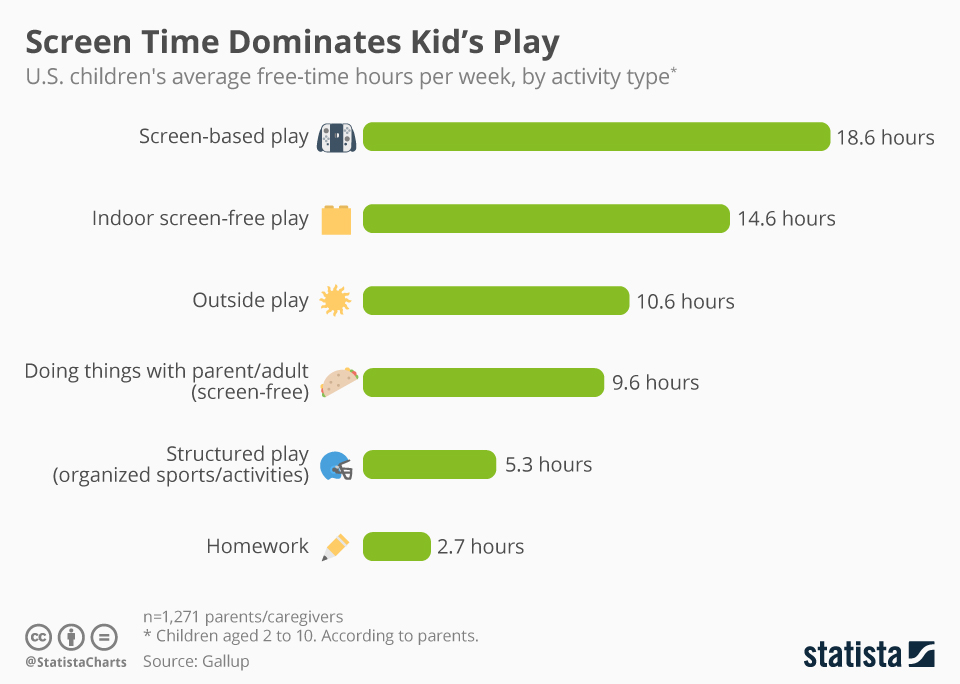
A Statista report on the Gallup study of kid’s play showed that screen time dominates by a large margin, with the average child aged 2 to 10 spending 18.6 hours per week of their free time on screen-based play. While the older the child, the more likely they are to use a device, this 18.6h/week (or 2.6h per day) is still significantly more than recommendations set by WHO and Canadian Paediatric Society.
Another study from 2022 analyzed the play patterns of 98 2, 4 and 5 years old preschool children, states that “[children’s] play with iPads is characterised as less ludic than play with other artefacts, and diverges from the age-typical norms of play”, indicating that there’s been a decline in spontaneous and unsupervised play in the recent years – a key factor for children’s mental and social development.
The impact of the COVID-19 pandemic
The COVID-19 pandemic left a profound impact on how and how much people, including children, use technology. Most services, jobs and even schools were either closed down or moved into the digital sphere.
An Italian study of 184 children and adolescents showed a surge in smartphone usage during the pandemic. Not only was there a significant increase in the total screen time (66% of children spent 4+ on the phone, compared to only 13% pre-pandemic), but the time between waking up and using the phone was shorter, with 56% of respondents reporting that there’s less than 5 minutes before they wake up and use their device (compared to 26% before COVID-19).
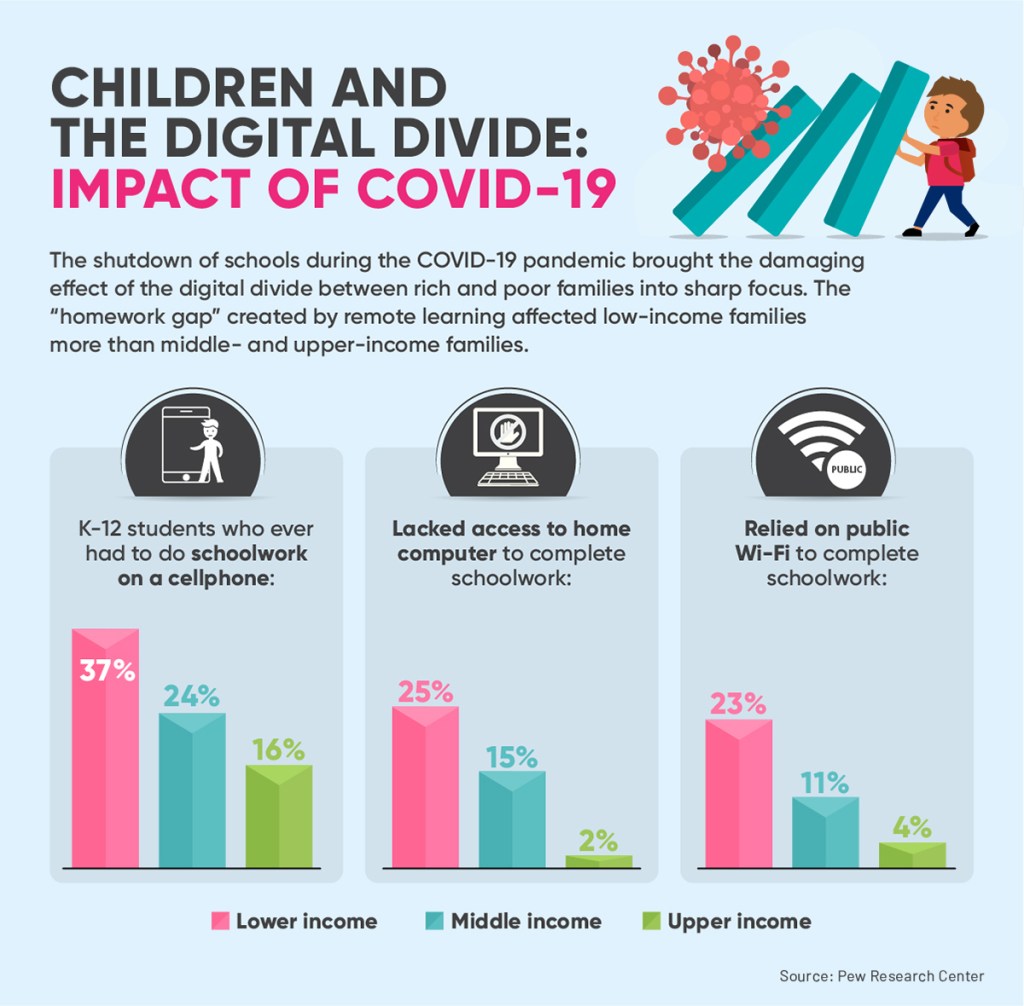
However, it’s worth to note that the pandemic disproportionately affected children from lower and middle class families, as K-12 children and teens from these households were often forced to complete their studies using their phones, and sometimes even using public WiFi.
If you’d like to read more about my perspective on the effectiveness of technology in classrooms, check out my article on the effectiveness of online education.
The effects of screen time on children
Technology designed for children has come a long way since the days of Speak & Spell. The improvements in user behavior tracking and increased complexity of software algorithms has allowed for more engaging and more personalized content to be available to a wide audience.
The general consensus for children is that less screen time is generally better because the ramifications of technology overuse in kids can be quite serious. However, the topic of children’s use of technology is nuanced, and there is a decent amount of research that highlights some potential benefits as well.
🟢 The benefits
While there are certain risks when it comes to children’s exposure to tech and the Internet, they may sometimes be warranted if the outcome is net positive for the child’s mental and physical health.
- Assistive technology (AT) can help children with disabilities learn more effectively.
- Educational technology makes learning more fun and engaging.
- Technology can help facilitate relationship building between children and their families during their physical absences, such as those caused by COVID-19 social distancing measures or military service.
🟥 The drawbacks
The challenge of listing drawbacks from technology use arises from the number of possible factors that influence behavior and health, including the pre-existing problems (physical/mental/social/behavioral…) that may simply get exacerbated by overuse of technology.
However, here are some examples of the possible issues that can come from children’s misuse or overuse of technology:
- Decreased language expression in children younger than 2
- Higher risk of obesity and musculoskeletal problems due to a sedentary lifestyle
- Potential for exposure to age-inappropriate content due to poor age restrictions on popular sites
I’d like to conclude this section with a quote from David Elkind, PhD, a professor emeritus of child development at Tulfts University, and the past president of the U.S. National Association for the Education of Young Children:
New technologies can facilitate the ways in which children learn, but they cannot accelerate the rate at which children grow.
Bottom line
New wave of digital natives – that is, children belonging to Gen Alpha and beyond – are virtually inseparable from technology.
The Internet democratized the ability to learn, be informed and complete manual tasks more easily. What’s more, in an ever-increasingly digitalized world, a smartphone has become a necessity, where you need a phone number and an Internet connection to open a bank account, order a new ID, use biometric (face/fingerprint) two-factor authentication, and for other common use-cases.
The ability to ignore these realities in favor of idealism is becoming a new form of privilege, afforded to only those with extra time or money.
The solution to this predicament is simple, but not easy. We need to teach children how to maximize the benefits of technology while avoiding being taken advantage of. The challenge comes from the fact that we’re fighting against thousands, if not millions of psychologists and designers who want to make technology as addictive and persuasive as possible.
Therefore, before teaching our own children, we should look at ourselves first: How are we using technology, and are we being taken advantage of? Are we using our attention, energy and time on the right things?

 Digital Sobriety
Leave a reply to SupremeCmdr Cancel reply