
Buying more stuff to distract yourself won’t work without larger changes.
Quick summary:
– An ‘analog bag’ is a tote filled with screen-free hobby items.
– Like most social media trends, it’s mainly a marketing ploy to get you to buy more things.
– The only real way to ‘fix’ your attention span is by reflecting on the behavioral and environmental patterns that that drive social media overuse in the first place, and then taking steps to address them.
If you’ve booted up a scrolling app in the last few months, you may have noticed a growing trend of people talking about ditching their glass screens with something ‘analog’.
As someone who’s been preaching digital minimalism, ‘unplugging’ from social media, and digital privacy since 2021, I was glad to see that more and more people are becoming aware of the physical/social/psychological harms of excessive social media use and/or doomscrolling (and more importantly, taking action against it).
However, with trends like the one we’ll cover today, I am worried that many people may fall into the trap of ‘quick fix’ trends — and get disappointed when they don’t work. While this kind of thing is inevitable to an extent in any self-development niche (think fitness, making money, etc.), I wanted to write this article for those that are genuinely ready to make real changes to improve their lifestyle, and to maintain those healthier habits long-term.
Why are Gen Zs packing their hobbies in a bag?
In short, being offline is ‘in’. And double coolness points are given for granny hobbies like knitting or sewing.
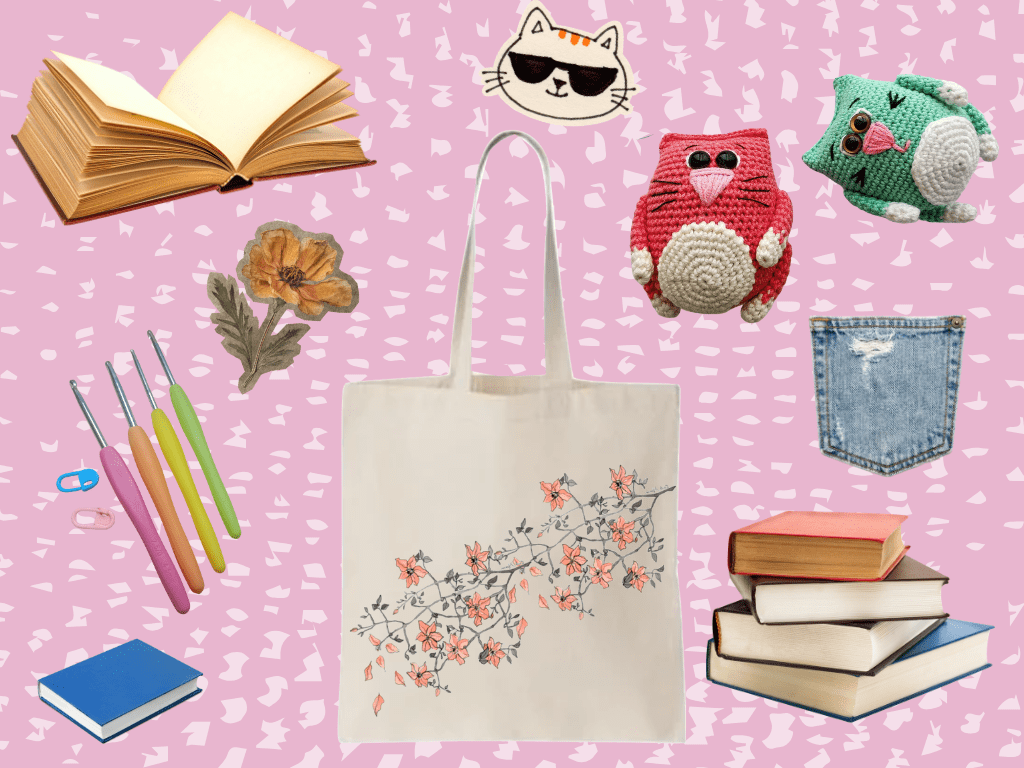
An analog bag is a tote or pouch filled with screen-free things to do instead of grabbing your phone (a book, journal, knitting material, puzzle book, a disposable camera…).
Here’s an example:
The idea behind the trend is to keep a stack of offline hobby items within reach while you’re out and about. So, instead of doomscrolling on your phone during idle moments like commuting, waiting, or hanging out at home.
The most recent trend was that of the ‘Analog Bag.’ The trend took off online after creator Sierra Campbell, popularized it as a way to replace doomscrolling with hands-on habits. However, like all influencer/social media trends, the Analog Bag movement is wrapped up in a consumerist packaging, and sold as a list of things you need to buy to fix your life. In this way, it’s no different from how jogging, sustainability, trifting, and minimalism started off as social movements with the right intentions, and got twisted into a marketing ploy to sell more things.
Why an Analog Bag won’t work
The analog bag trend makes sense on the surface. Pack a few wholesome hobbies into a tote, carry them around, and reach for the crochet project instead of your phone.
However, this solution has 3 major flaws:
- It doesn’t address the real issues that lead to doomscrolling.
- It’s not convenient, so it won’t stick long-term.
- It’s basically feel-good marketing for more unnecessary consumption.
Problem #1: You can’t buy your way into mental health and better habits.
An analog bag may interrupt phone use for a moment, but it doesn’t actually change the habits, emotions, and systems that drove your compulsive scrolling in the first place.
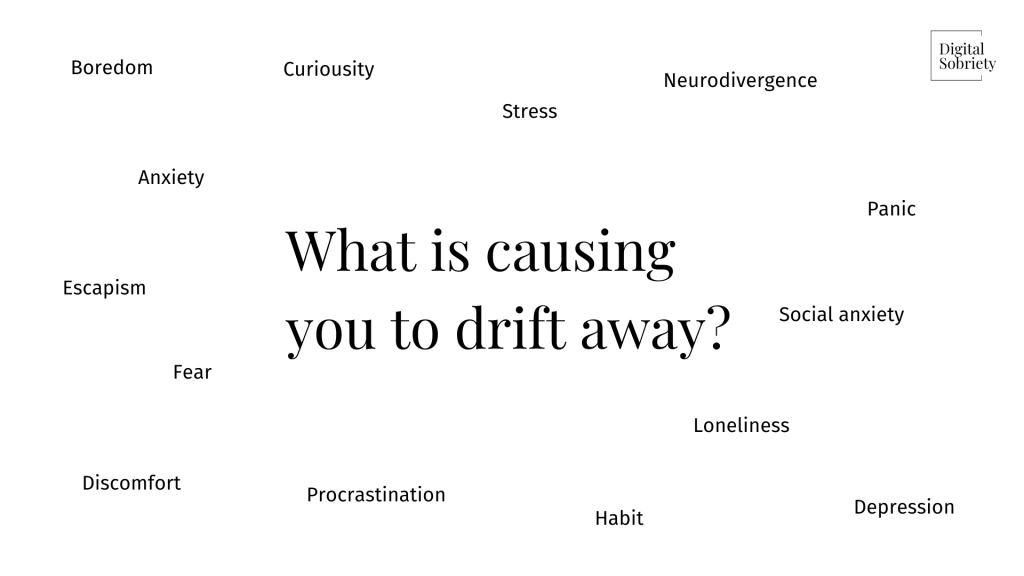
Most people doomscroll to escape. We’re trying to suppress or escape stress, boredom, loneliness, fatigue, anxiety… “everyone’s running from something”, as the saying goes.
A bag full of offline activities does not automatically solve any of that. Bandaid solutions like this are often used as a self-soothing mechanism to feel like you’re making a difference, without changing the larger behavioral and environmental issues that caused the negative pattern in the first place (this is a pattern we often see in self-help).
Problem #2: Who’s gonna carry a heavy tote all day?
The answer is: no one. Not even the influencers who make these videos. After all, who wants to lug around 6 different books, a crochet kit, a guidebook and a crafting set every. single. day?
The other important question is why do people doomscroll? The answer: because it’s dead easy. Their phones are already in their pockets, on their desks, and beside their beds. The slab of metal is tiny and light enough to be able to take it out at any point. The motion of scrolling could not demand less energy than it currently does (until we inevitably come up with eye-controlled wearables).
In other words, people doomscroll because you don’t have to make an in-the-moment decision on what entertainment to consume. You’re already scrolling by the time your brain catches up with your muscle memory.
An analog bag, on the other hand… is not convenient at all. An analog bag asks a person to stop, open a different container, choose an activity, make a choice of what to do and actually focus on the task at hand.
Even if you had the strength to resist the siren’s scroll, it’s not realistic to maintain that level of willpower and intention long-term. So, in the long-run, the easier option will win. Always.
Problem #3: Turning lifestyle into a performance (and a marketing tool)
The most grating aspect of this trend is that it’s turning a behavioral problem into a shopping list. It packages up a tried-and-true ‘What’s in my bag’ video format with a fresh coat of paint made up of people’s anxieties about social media and tech overuse.
The content itself is nothing but a rapid-fire showcase of a series of products that are meant to ‘fix your life/attention span’ without any nuance on the individual’s real day-to-day habits. And similarly to other ‘detox’ videos, it relies on feel-good marketing to sell you products.
The last part of the social media trend pie is the ✨ aesthetic✨ nature of the videos. Looks are everything to us. Social signaling is more important to humans than real benefits. This is why rich people build libraries to signal intelligence, and why poor people buy expensive brand items to signal prosperity. And it’s why people are buying ‘analog’ items to signal being offline (because not being on social media is ‘cool’ now).
In short…
Instead of building discipline, setting boundaries, or practicing reflection, people buy supplies and hope this new shiny toy will change their life. A person may assemble the perfect bag, post it online… only to then spend 3 hours scrolling in bed that same night anyways. The self-improvement is turned into a performance without truly breaking the patterns.
How to fix doomscrolling (the right way)
Doomscrolling reflects a relationship with discomfort, attention, and control. A tote bag full of wholesome objects cannot solve that on its own. Real progress comes from understanding why the phone keeps winning and then making that pattern harder to repeat. While this approach isn’t as Instagram-able, it will actually work.
What I found works for me is to follow the principles of digital minimalism and occasional self-check-ins to make sure I’m happy with my current relationship with tech. If something feels wrong, I take reasonable changes to improve the situation.
Here’s what you need to do to make real progress (I’ve been on this journey for 5+ years, and this is what worked for me).
The 5-step plan to digital sobriety
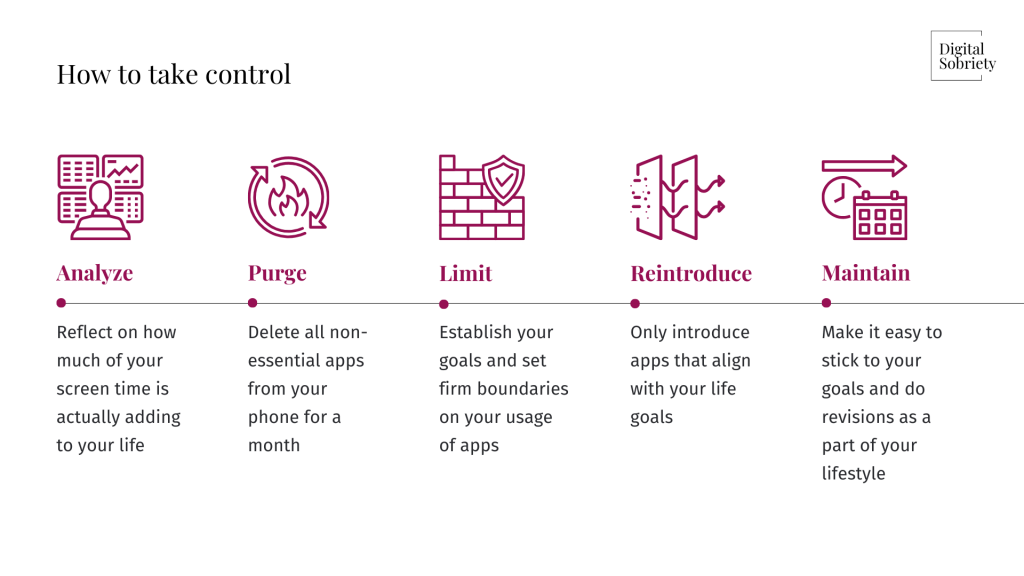
- Analyze: Reflect on how much of your screen time is actually adding to your life.
- Purge: Delete all non-essential apps from your phone for a month.
- Limit: Establish your goals and set firm boundaries on your usage of apps.
- Reintroduce: Only introduce apps that align with your life goals.
- Maintain: Make it easy to stick to your goals and do revisions as a part of your lifestyle.
💡 Resource
I created a full step-by-step checklist covering this in more detail (it’s free and no email sign up!)
See the checklist →
This system is based on a long-term strategy that, while more difficult to set up and maintain, doesn’t rely on short-term motivation or trendy aesthetics — and will actually bring results.
Like with most self-improvement (exercise, eating habits, mindfulness…), the end-goal isn’t perfection. The goal is to find balance and a healthier relationship with technology. It’s okay to get excited about new tech. It’s okay to be on social media. What is not ok is if your digital habits are negatively impacting your quality of life, or the goals you want to achieve.
The key to long-term digital sobriety is in the maintenance stage: accepting that this is a lifelong journey of ups and downs, and not something that can be addressed with a band-aid solution that offers a temporary feeling of success over real progress.
 Digital Sobriety
Leave a comment