
Here’s how to balance between staying informed and getting overwhelmed.
Try these tips for news fatigue:
- Reduce news access points
- Use structured formats for reading the news
- Disable any news notifications
- Curate carefully and with intention
In my latest workshop, one of the attendees mentioned that he had a great control over his social media habits (his screen time was even lower than he expected!), but that news were his Kryptonite.
“I have multiple apps for each news outlet I read from… going from app to app to hear different viewpoints and analyses takes up a lot of my time.”
Soon after sharing his story, another attendee spoke up and said they had a similar problem.
More specifically, both of them wanted to keep up with the news to stay informed, but that they were often getting lost in doomscrolling, and overall spent a lot more time on the apps than they initially wanted to.
I suspected this was something that a lot of people struggle with, so I went digging.
The way we consume news has changed
In the last few decades, people have moved to reading news digitally, and primarily on their phones. In the UK, 73% of people get their news online.
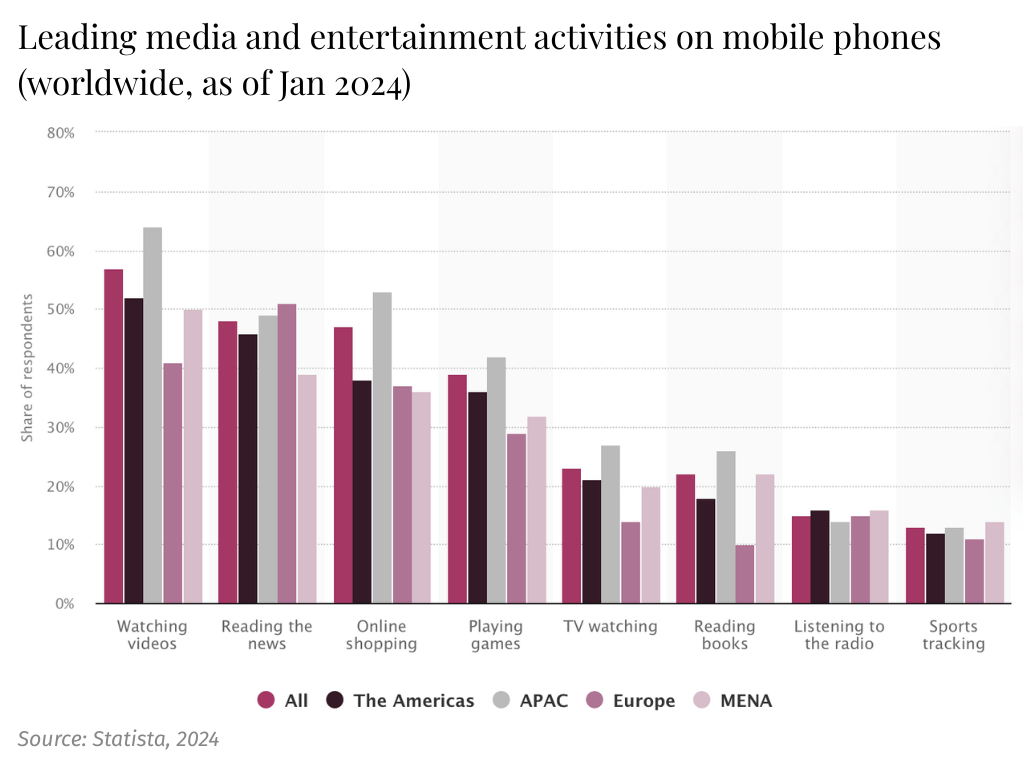
Just look at the graph below… Reading the news is the 2nd most popular activity on mobile phones, as of 2024:
It’s no surprise why digital news media is winning: digital formats are more flexible and accessible than traditional physical newspaper.
We’re definitely spoiled for choice when it comes to how we want to consume our news. Information is widely available, in increasingly more flexible formats. We can consume news wherever, whenever and however we want to, for free.
Nowadays, you can get your news via:
- News sites and apps
- Aggregator apps like Google and Apple News
- Social media (Twitter/X posts, specific subreddits,…)
- AI chatbots like ChatGPT or Perplexity
- Curated email send-outs from Pocket, Morning Brew…
- Podcasts
- Voice assistants
News is becoming more personalized
The way we consume news has changed so much that the very definition of the word “news” has changed somewhat. In the past, news was strictly associated with journalism. But nowadays, audiences shape the meaning of news, not journalists.
Pew Research recently did an interesting study on this topic, and, among other things, found that:
- People’s decisions on what was considered news were very individual.
- Personal importance played a key role in what someone considered news. So, for example, if you’re an immigrant, changes to visa laws will be news to you, while the same doesn’t apply to the holder of citizenship of that country.
From this, it follows that you, as an individual, can decide what news is to you.
Being able to shape what media we consume, and how, is good, because it empowers us personalize the medium to our specific needs, lifestyle and overall preferences.
If we don’t have time to read the news for the industry we work in (as following the news can be a job on its own), we can listen to a relevant podcast that provides regular updates.
New media, new problems
Just like traditional media had many problems associated with centralization of information, new media also carry some problems.
Design “flaws”
The word “flaws” is in quotation marks because:
- Some of these problems are operating by design. It’s just an anti-consumer design, hence, it’s flawed.
- Other times, they’re unavoidable consequences of modern marketing practices. We can debate the morality of news channels exploiting negativity bias, but if that’s the only way they make money, they won’t stop.
News sites are actively incentivized to promote negativity because using lots of negative words in titles brings significantly more clicks to the sites (measured in click-through-rate/CTR, see screenshot below).
With more and more news outlets actively bleeding traffic due to Google’s AI Overviews and chatbots, this trend is bound to get even worse.

Social media is designed to encourage echo-chambers, where misinformation gets spread like wildfire. So much so that social media platforms are actively implementing features to combat this exact issue:
- Twitter/X introduced Community Notes for the purpose of fact-checking information and dubious ads on the platform.
- YouTube introduced notes under videos that discuss sensitive topics like healthcare.
AI chatbots are, at least as of writing this article, very unreliable at summarizing the news. BBC’s recent study showed that 51% of news summarized by chatbots had inaccuracies. In other words, your source being accurate is down to a coin flip.
News fatigue
News fatigue isn’t a new concept, but it’s been increasingly used as a term to describe information overload: the overwhelm we feel from too much news exposure.
Unsurprisingly, the term was most searched during the covid-19 pandemic. It turns out, being stuck at home, while exposed to a never-ending stream of reminders of how bad things are in the world, may cause people to feel overwhelmed and anxious.

Long story short…
If you’re feeling anxious and overwhelmed from the constant onslaught of negativity in the news, but are unable to stop reading them, you’re far from the only one. Millions are struggling with this same problem.
But what can you do about it?
The next section will explain strategies you can use to combat news fatigue and burnout, and how to build systems that truly.
Strategies for combating news burnout
If you’re feeling overwhelmed by the news, here’s what you should do:
- For immediate relief
- To build a long-term system for a more mindful news consumption
1. Immediate actions to reduce overwhelm right now
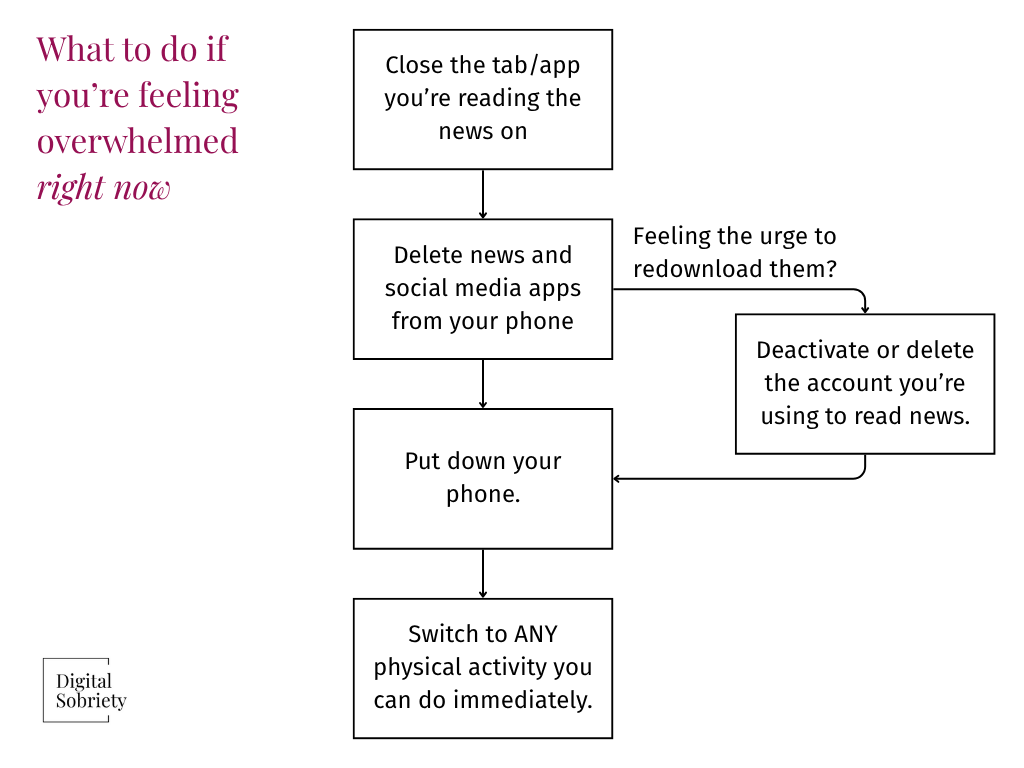
Here’s what you should do right now, in that order:
- Close the tabs or app you’re using to read the news right now.
- Delete news and social media apps from your phone (or whatever other app you’re using to read the news). Keep them deleted for 4 weeks. If you’re feeling the urge to download them again, deactivate or delete your account.
- Put down your phone. Switch to physical activity that’s calming (or at least neutral), like walking, stretching, reading, journaling or assembling a puzzle.
2. Long-term strategies for sustainable news habits
The goal of these strategies is to create a structure around how you consume news. Reading the news on its own isn’t bad, it’s overdoing it that causes issues.
So, we’ll want to create intentional systems to prevent overconsumption.
Set intentional goals
Clarity and self-reflection are the keywords here. You must have both to be able to build mindful, healthier habits around your news consumption.
- Ask yourself why you’re reading the news. Is it out of civic duty? Fear? Curiosity about a particular topic? Or just plain-old boredom?
- Allocate a specific time of day for checking the news. For example: “I’ll only read the news during my 10-minute morning coffee.”
- Understand that you don’t need to know everything to be well-informed. Nowadays every news story is ‘breaking news’. You should accept the fact that you’ll never be 100% informed, and that’s okay. We only have so much time. Do you want to spend all of it reading about life, or actually living it?
Curate and simplify
The key step to reducing overwhelm long-term is to reduce the number of sources you actually get news from. Quality > quantity.
- Stick to 1–3 high-quality sources. Pick a small set of outlets and resist the temptation to broaden the scope. Personally, I get most of my economics and political news from The Economist.
- Use an RSS reader to cut through the algorithms. RSS feeds are great because they’re boring visually and you don’t get personalized recommendations. I work in international higher education, so I have to follow news from 10-15 different outlets because it directly impacts our work. RSS feeds are my saving grace: I’m able to stay on top industry news without getting sucked into mindless scrolling.
- Unsubscribe ruthlessly: Review your email inbox, YouTube subscriptions, and podcasts. Unsubscribe from sensationalist and/or redundant content. Keep what actually adds value.
Design for your sanity
Craft an environment and routine to protect your mental space.
- Avoid the news first thing in the morning and last thing at night. If you feel the need for mental stimulation, try journaling, reading, or listening to music.
- Slow down. Read weekly digests or listen to in-depth podcasts instead of chasing constant updates. Depth over speed.
- Practice regular “news fasts”. If you have to read news multiple times a week, go completely news-free for at least 2-3 days. Use that time for reflection, books, or engaging with loved ones.
- Designate a physical space where you do consume news. Make that your “news” area and avoid reading them elsewhere.
Redefine your perspective
Instead of eliminating news entirely, you can shift your focus to more constructive formats and perspectives.
- Prioritize solutions journalism. Solutions journalism highlights responses and potential fixes to social problems. It’s great for fighting constant doom-and-gloom narratives.
- Support local journalism (if you aren’t already). In other words, news from your city/town or even municipality. National and international crises can be overwhelming, particularly because we know we can’t impact outcomes all that much. Local news, on the other hand, often offers tangible stories you can act on directly. Plus, they’re usually unappreciated, so you’ll be helping preserve your local news efforts.
- Talk to people you know in real life. Discuss one meaningful story with a friend, partner or family member. Sharing our thoughts helps us process them. Plus, it’s a nice excuse to catch up with the person!
Tools to help you in your journey
| Tool | Name |
| App blockers | Freedom, Cold Turkey, Forest |
| “Digest” tools | Readwise or Pocket |
| Minimalist reading environments | Reader Mode (built-in) or Pocket (extension/app) |
| RSS feed readers | Feeder, NetNewsWire (iPadOS) Feedreader (web) |
| Analytics tools | Screen time and “pick up” statistics (you can see them in your Settings app) |
 Digital Sobriety
Leave a comment